Modern engineering increasingly relies on materials that control light and energy at extremely small scales. As performance requirements tighten across display systems, energy technologies, and biomedical applications, conventional materials can lose precision where optical control matters most. Quantum confinement in semiconductor nanocrystals has long been established as the mechanism behind size-dependent emission behavior, and quantum-dot layers can improve color performance and energy efficiency in real systems.
That combination of tunable light emission and system-level efficiency is why quantum dots continue to matter in advanced engineering. In display architectures, quantum dot enhancement structures have been studied for their ability to improve color gamut and reduce energy loss.
For engineering teams working at the component level, these material advances introduce new requirements around integration, protection, and consistency. Custom Materials Inc. supports this layer of execution through precision fabrication across films, insulation materials, and custom components—ensuring that sensitive material systems perform reliably within real-world assemblies where dimensional stability, environmental resistance, and repeatable tolerances are critical.
What Are Quantum Dots?
Quantum dots are tiny nanoscale semiconductor particles, typically 2–10 nm in size of quantum dots, where quantum size effects define behavior. These nanocrystal quantum structures exhibit properties that differ from bulk materials due to the quantum confinement of electrons.
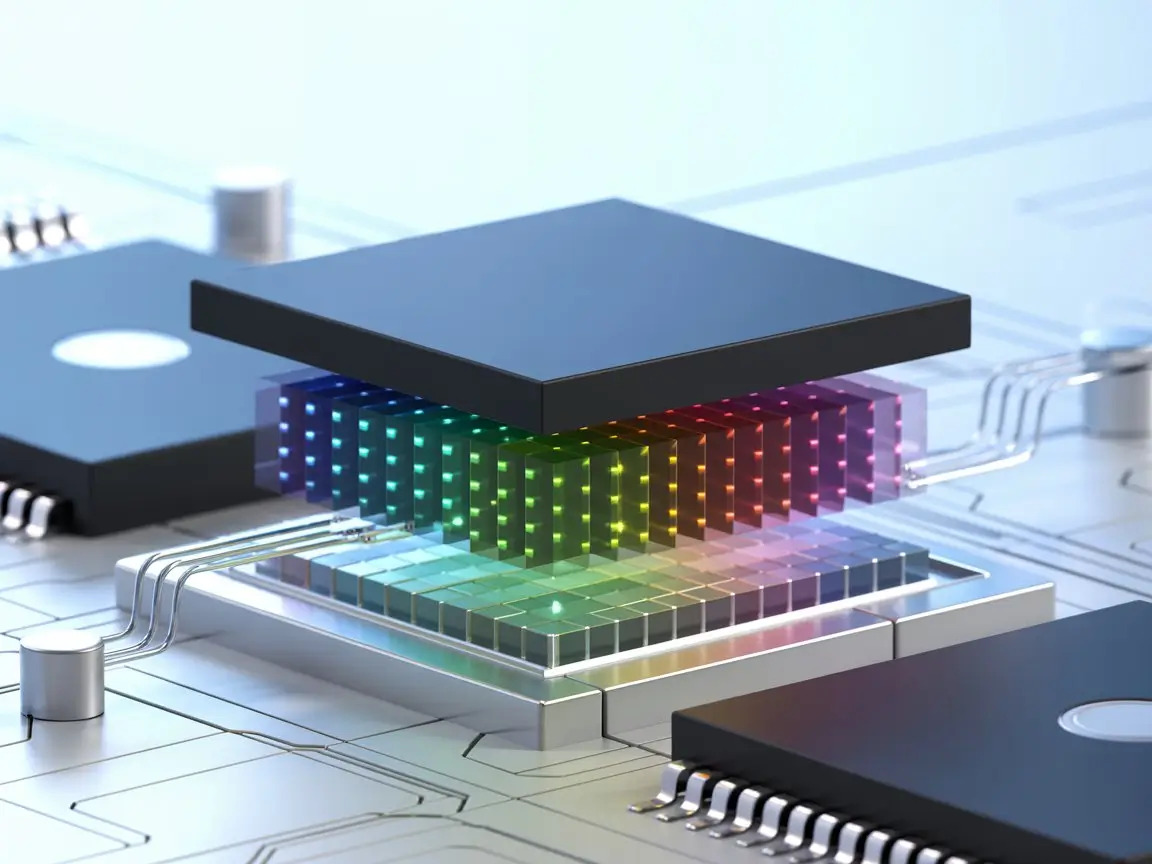
These semiconductor quantum dots can be engineered to emit specific wavelengths. In simple terms, sized quantum dots emit different colors of light due to quantum confinement.
Core Properties of Quantum Dots
- Size-dependent emission
- High color purity
- High quantum yield and fluorescence quantum yield
- Tunable bandgap
- Strong absorption efficiency
These properties of quantum dots allow precise optical control in engineering systems.
Quantum Confinement in Semiconductor Quantum Dots
Quantum confinement is the fundamental principle that defines how quantum dots behave.
When electrons are confined within a nanoscale semiconductor structure, their energy levels become discrete rather than continuous. This directly affects how the material absorbs and emits light.
Smaller quantum dots → higher energy emission (blue spectrum)
Larger quantum dots → lower energy emission (red spectrum)
This size-to-wavelength relationship allows engineers to design materials with predictable optical output, which is critical in photonic and energy systems. The emitted photon energy depends on particle size.
In engineering terms, quantum dots act as tunable optical converters, enabling controlled emission and absorption.
Optical Properties of Quantum Dots
The optical properties of quantum dots are what make them valuable in advanced engineering systems.
Size-Dependent Emission and Color Control
Quantum dots emit light at very specific wavelengths based on their size. This enables:
- Precise color tuning
- Narrow emission bandwidths
- High color stability over time
This level of control is particularly important in display and imaging systems where spectral accuracy affects performance.
Photoluminescence and Energy Efficiency
Quantum dots exhibit strong photoluminescence, meaning they efficiently convert absorbed energy into emitted light.
This contributes to:
- Higher brightness efficiency in displays
- Reduced energy loss in optical systems
- Improved signal clarity in imaging applications
Together, these properties enable more efficient light management compared to conventional materials.
Types of Quantum Dots
Different types of quantum dots are used depending on the application and performance requirements.
Core-Shell Quantum Dots
Core-shell quantum dots consist of a semiconductor core surrounded by a shell material.
- The shell improves stability
- Reduces surface defects
- Enhances emission efficiency
These are commonly used in display and biomedical applications where durability and consistency are critical.
Colloidal Quantum Dots
Colloidal quantum dots are synthesized in solution and can be deposited into films or coatings.
- Suitable for large-area applications
- Compatible with flexible substrates
- Used in displays and solar technologies
Semiconductor Quantum Dots by Material
Different semiconductor compositions offer different performance characteristics:
- CdSe (cadmium selenide) → strong optical performance
- InP (indium phosphide) → reduced toxicity alternative
- PbS (lead sulfide) → infrared applications
Material selection depends on regulatory constraints, wavelength requirements, and system integration needs.
How Quantum Dots Are Made

Understanding how quantum dots are made is critical for evaluating performance.
Synthesis of Quantum Dots
Quantum dots are typically quantum dots synthesized using:
- Colloidal chemistry
- Epitaxial growth (using an epitaxial quantum well)
- Nanocrystals using an epitaxial quantum process
These methods enable controlled size and structure.
Production Challenges
- Maintaining uniform size
- Preventing aggregation
- Ensuring repeatability
The production of quantum dots must be tightly controlled to achieve high-quality quantum dots with consistent optical output.
Why Optical Control Matters in Engineering Systems
In advanced systems, performance depends on how precisely materials interact with light.
Conventional materials often face limitations such as:
- Fixed spectral output
- Energy loss during light conversion
- Reduced imaging sensitivity
Quantum dots address these limitations by enabling wavelength-specific control of emission and absorption.
Engineering Advantages
- Improved spectral precision
- Higher optical conversion efficiency
- Enhanced imaging signal clarity
- Reduced energy loss across systems
This allows quantum dots to function as active components in system design, rather than passive materials.
Applications of Quantum Dots
Display technologies
Quantum dots are widely used in display systems to improve color accuracy and energy efficiency. By integrating quantum dot layers into backlighting systems, displays can achieve a wider color gamut, higher brightness efficiency, lower energy consumption, and improved color stability.
Industry and display-science references continue to support quantum-dot use in QLED and color-conversion architectures, especially where compact form factors and high visual performance are both priorities.
Solar energy systems
Quantum dots are being evaluated in photovoltaic systems for their ability to improve spectral absorption efficiency. Their tunable bandgap allows absorption across a broader portion of the solar spectrum than conventional materials in some configurations.
Solar research has explored quantum dots for multi-junction architectures, thin-film designs, and flexible photovoltaic concepts.
Key development areas include:
- Multi-junction solar cell optimization
- Expanded spectral absorption range
- Reduced conversion losses
- Flexible photovoltaic integration potential
Biomedical imaging
Quantum dots are used in imaging systems because of their brightness, photostability, and narrow emission spectra. Compared with traditional fluorescent dyes, they can offer higher resistance to photobleaching and longer imaging stability, which supports molecular labeling and long-duration tracking
These properties support:
- Higher signal-to-noise imaging
- Long-duration tracking
- Targeted molecular visualization
- Improved diagnostic resolution
Engineering Considerations and Limitations
Despite their advantages, quantum dots introduce important engineering constraints. Some materials degrade under oxygen, moisture, or heat exposure, which affects long-term performance. Manufacturing consistency is another challenge, since optical output depends heavily on uniform particle size distribution and tightly controlled synthesis.
Integration can also be difficult because quantum dots must be embedded into films, coatings, or composites before practical use. Material composition adds another layer of complexity, since some formulations involve cadmium or other regulated substances.
Integrating Quantum Dots into Real-World Systems
For Custom Materials Inc., the focus is not on producing quantum dots, but on enabling their reliable integration.
Advanced materials like quantum dots depend on supporting structures that maintain:
- Dimensional stability
- Environmental protection
- Mechanical integrity
- Repeatable performance across production
Custom Materials Inc. provides precision fabrication across:
- Films and layered materials
- Electrical insulation components
- Custom-cut and formed parts
These capabilities support industries including energy systems, transportation, and medical technologies, where small, high-performance components play a critical role in overall system reliability.
As quantum-dot applications expand, the importance of fabrication quality and integration precision becomes increasingly central to system performance.
For Custom Materials Inc., the most relevant angle is not producing quantum dots themselves, but supporting the precision structures that allow advanced materials to function reliably. That includes films, coatings, layered assemblies, and small isolated components used in energy, transportation, medical, and defense-adjacent systems.
As quantum-dot applications expand, fabrication quality becomes increasingly important in the surrounding structure. Clean edges, dimensional accuracy, and compatibility with host materials all affect whether the final system performs consistently.
Why Quantum Dots Matter in Modern Engineering

Quantum dots represent a shift toward nanoscale materials where quantum effects define performance.
They are particularly valuable because:
- They enable controlled optical behavior
- They improve system efficiency
- They support miniaturization
Key Takeaway
Quantum dots are nanoscale semiconductor materials with size-dependent optical properties that enable precise control of light emission and absorption.
Their value lies in enabling high-efficiency, precision-driven systems across display, energy, and biomedical applications.
As adoption grows, successful implementation will depend not only on the material itself, but on how effectively it is integrated into real-world systems through precise fabrication and engineering control.
Custom Materials Inc. supports this layer of execution through precision fabrication of films, insulation materials, and custom components used in energy, transportation, and medical systems. These capabilities help ensure that advanced materials, including quantum dot-based assemblies, perform consistently under real operating conditions.
Contact our engineering team to review your fabrication requirements.
Frequently Asked Questions
What are quantum dots in engineering?
Quantum dots in engineering are nanoscale semiconductor materials used to control light emission and absorption with high precision. Their size-dependent optical behavior makes them useful in systems such as displays, solar energy devices, and biomedical imaging technologies.
What are the key properties of quantum dots?
Key properties include size-dependent optical emission, tunable bandgap, high photoluminescence efficiency, narrow spectral output, and strong light absorption. These characteristics enable precise control of optical performance in engineered systems.
What are the main types of quantum dots used in engineering?
Common types include core-shell quantum dots for enhanced stability and efficiency, colloidal quantum dots for scalable film and coating applications, and semiconductor quantum dots made from materials such as cadmium selenide (CdSe) or indium phosphide (InP), depending on performance and regulatory requirements.
What are typical applications of quantum dots in engineering?
Quantum dots are used in display technologies for improved color accuracy and efficiency, in solar energy systems for enhanced spectral absorption, and in biomedical imaging for high-resolution, stable fluorescence-based diagnostics.
How are quantum dots used in real engineering systems?
Quantum dots are typically integrated into films, coatings, or composite materials within a system. Their performance depends not only on the material itself but also on precise fabrication, environmental protection, and compatibility with surrounding components.